


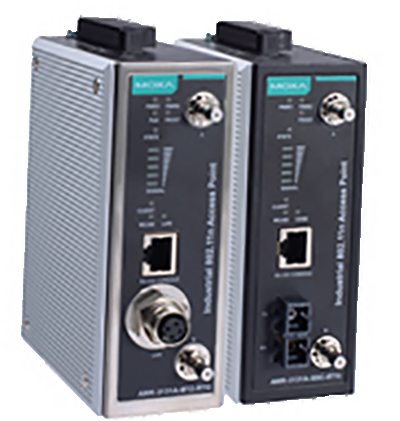
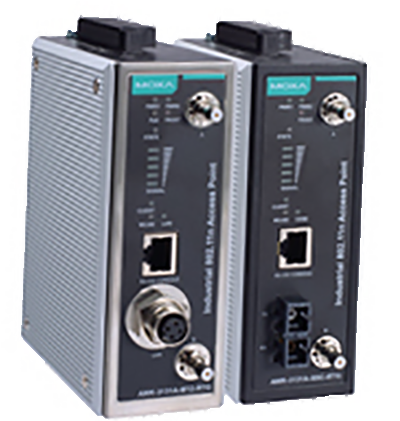
MOXA AWK-3131A-RTG Series
Industrial IEEE 802.11a/b/g/n wireless AP/client
 Proprietà
 Descrizione
 Further informazioni
 Prodotti similari
 Stampare questa pagina
 Richiedere un prezzo
 Mostrare le miei note
 PDF
PDF
 Proprietà
 Descrizione
 Further informazioni
 PDF
PDF
- IEEE 802.11a/b/g/n compliant
- M12 anti-vibration connectors (AWK-3131A-M12-RTG)
- SC optical fiber connection (AWK-3131A-SSC-RTG)
- QoS (WMM) and VLAN for efficient network traffic
- Controller-based Turbo Roaming (handover time < 50 ms @ 3 channels, WPA2) - available only when used with the WAC-1001 or WAC-2004
- Complies with all EN 50155 mandatory test items
- -40 to 75°C operating temperature range (T models)
The AWK-3131A-RTG 3-in-1 industrial AP/client devices are designed specifically for train-to-gound communication while moving at speeds of up to 120 km/h. The AWK-3131A-RTG complies with a portion of EN 50155 specifications, covering operating temperature, power input voltage, surge, ESD, and vibration, making the AWK-3131A-RTG suitable for a variety of industrial applications. Installation is easy, with either DIN-rail mounting or distribution boxes, and the DIN-rail mounting capability, wide operating temperature range, and IP30 housing with LED indicators make the AWK-3131A-RTG a convenient yet reliable solution for any rolling stock application.
Advanced Security
- 64-bit and 128-bit WEP (Wired Equivalent Privacy)
- Enable/disable SSID broadcasts
- WPA/WPA2 (Wi-Fi Protected Access) and 802.11i support
- IEEE802.1X/RADIUS support
- Powerful filters for access control
Specifications for Train-to-Ground Applications
- Client-based Turbo Roaming handover time < 150 ms @ 3 channel with WPA2
- Controller-based Turbo Roaming handover time (available only when used with the WAC-1001 or WAC-2004) < 50 ms @ 3 channels with WPA2
- Multiple roaming parameters for different installation structures and antenna types
Specification
| WLAN Interface | |||||||||||||||
| WLAN Standards | 2.4 GHz: 802.11b/g/n with 64 QAM support, 20/40 MHz 5 GHz: 802.11a/n with 64 QAM support, 20/40 MHz | ||||||||||||||
| Frequency Band for US (20 MHz operating channels) |
AWK-3131A-RTG-US models only: 2.412 to 2.462 GHz (11 channels) 5.180 to 5.240 GHz (4 channels) 5.260 to 5.320 GHz (4 channels)1 5.500 to 5.700 GHz (8 channels) excluding 5.600 to 5.640 GHz2 5.745 to 5.825 GHz (5 channels) | ||||||||||||||
| Frequency Band for EU (20 MHz operating channels) |
AWK-3131A-RTG-EU models only: 2.412 to 2.472 GHz (13 channels) 5.180 to 5.240 GHz (4 channels) 5.260 to 5.320 GHz (4 channels)2 5.500 to 5.700 GHz (11 channels)2 | ||||||||||||||
| Frequency Band for JP (20 MHz operating channels) |
AWK-3131A-RTG-JP models only: 2.412 to 2.484 GHz (14 channels) 5.180 to 5.240 GHz (4 channels) 5.260 to 5.320 GHz (4 channels)2 5.500 to 5.700 GHz (11 channels)2 | ||||||||||||||
| Wireless Security | SSID broadcast enable/disable, WEP encryption (64-bit and 128-bit), WPA/WPA2-Enterprise (IEEE 802.1X/RADIUS, TKIP, AES), WPA/WPA2-Personal | ||||||||||||||
| Transmission Rate | 802.11b: 1 to 11 Mbps, 802.11a/g: 6 to 54 Mbps, 802.11n: 6.5 to 300 Mbps | ||||||||||||||
| Transmitter Power for 802.11a | 23±1.5 dBm @ 6 to 24 Mbps, 21±1.5 dBm @ 36 Mbps, 20±1.5 dBm @ 48 Mbps, 18±1.5 dBm @ 54 Mbps | ||||||||||||||
| Transmitter Power for 802.11n (5 GHz) |
23±1.5 dBm @ MCS0 20 MHz, 20±1.5 dBm @ MCS1 20 MHz, 20±1.5 dBm @ MCS2 20 MHz, 20±1.5 dBm @ MCS3 20 MHz, 19±1.5 dBm @ MCS4 20 MHz, 18±1.5 dBm @ MCS5 20 MHz, 18±1.5 dBm @ MCS6 20 MHz, 18±1.5 dBm @ MCS7 20 MHz, 23±1.5 dBm @ MCS8 20 MHz, 20±1.5 dBm @ MCS9 20 MHz, 20±1.5 dBm @ MCS10 20 MHz, 20±1.5 dBm @ MCS11 20 MHz, 19±1.5 dBm @ MCS12 20 MHz, 19±1.5 dBm @ MCS13 20 MHz, 18±1.5 dBm @ MCS14 20 MHz, 18±1.5 dBm @ MCS15 20 MHz, 23±1.5 dBm @ MCS0 40 MHz, 20±1.5 dBm @ MCS1 40 MHz, 20±1.5 dBm @ MCS2 40 MHz, 20±1.5 dBm @ MCS3 40 MHz, 19±1.5 dBm @ MCS4 40 MHz, 18±1.5 dBm @ MCS5 40 MHz, 18±1.5 dBm @ MCS6 40 MHz, 18±1.5 dBm @ MCS7 40 MHz, 23±1.5 dBm @ MCS8 40 MHz, 20±1.5 dBm @ MCS9 40 MHz, 20±1.5 dBm @ MCS10 40 MHz, 20±1.5 dBm @ MCS11 40 MHz, 19±1.5 dBm @ MCS12 40 MHz, 19±1.5 dBm @ MCS13 40 MHz, 18±1.5 dBm @ MCS14 40 MHz, 18±1.5 dBm @ MCS15 40 MHz | ||||||||||||||
| Transmitter Power for 802.11b | 26±1.5 dBm @ 1 Mbps, 26±1.5 dBm @ 2 Mbps, 26±1.5 dBm @ 5.5 Mbps, 25±1.5 dBm @ 11 Mbps | ||||||||||||||
| Transmitter Power for 802.11g | 23±1.5 dBm @ 6 to 24 Mbps, 21±1.5 dBm @ 36 Mbps, 19±1.5 dBm @ 48 Mbps, 18±1.5 dBm @ 54 Mbps | ||||||||||||||
| Transmitter Power for 802.11n (2.4 GHz) |
23±1.5 dBm @ MCS0 20 MHz, 21±1.5 dBm @ MCS1 20 MHz, 21±1.5 dBm @ MCS2 20 MHz, 21±1.5 dBm @ MCS3 20 MHz, 20±1.5 dBm @ MCS4 20 MHz, 19±1.5 dBm @ MCS5 20 MHz, 18±1.5 dBm @ MCS6 20 MHz, 18±1.5 dBm @ MCS7 20 MHz, 23±1.5 dBm @ MCS8 20 MHz, 21±1.5 dBm @ MCS9 20 MHz, 21±1.5 dBm @ MCS10 20 MHz, 21±1.5 dBm @ MCS11 20 MHz, 20±1.5 dBm @ MCS12 20 MHz, 19±1.5 dBm @ MCS13 20 MHz, 18±1.5 dBm @ MCS14 20 MHz, 18±1.5 dBm @ MCS15 20 MHz, 23±1.5 dBm @ MCS0 40 MHz, 20±1.5 dBm @ MCS1 40 MHz, 20±1.5 dBm @ MCS2 40 MHz, 20±1.5 dBm @ MCS3 40 MHz, 19±1.5 dBm @ MCS4 40 MHz, 19±1.5 dBm @ MCS5 40 MHz, 18±1.5 dBm @ MCS6 40 MHz, 17±1.5 dBm @ MCS7 40 MHz, 23±1.5 dBm @ MCS8 40 MHz, 20±1.5 dBm @ MCS9 40 MHz, 20±1.5 dBm @ MCS10 40 MHz, 20±1.5 dBm @ MCS11 40 MHz, 20±1.5 dBm @ MCS12 40 MHz, 19±1.5 dBm @ MCS13 40 MHz, 18±1.5 dBm @ MCS14 40 MHz, 17±1.5 dBm @ MCS15 40 MHz | ||||||||||||||
| Receiver Sensitivity for 802.11a (measured at 5.680 GHz) |
Typ. -90 @ 6 Mbps, Typ. -88 @ 9 Mbps, Typ. -88 @ 12 Mbps, Typ. -85 @ 18 Mbps, Typ. -81 @ 24 Mbps, Typ. -78 @ 36 Mbps, Typ. -74 @ 48 Mbps, Typ. -74 @ 54 Mbps, Note: Due to a limitation in the receiver sensitivity performance for channels 153 and 161, it is recommended to avoid using these channels in your critical applications. | ||||||||||||||
| Receiver Sensitivity for 802.11n (5 GHz; measured at 5.680 GHz) |
Typ. -88 dBm @ MCS0 20 MHz, Typ. -85 dBm @ MCS1 20 MHz, Typ. -82 dBm @ MCS2 20 MHz, Typ. -79 dBm @ MCS3 20 MHz, Typ. -76 dBm @ MCS4 20 MHz, Typ. -71 dBm @ MCS5 20 MHz, Typ. -70 dBm @ MCS6 20 MHz, Typ. -69 dBm @ MCS7 20 MHz, Typ. -95 dBm @ MCS8 20 MHz, Typ. -91 dBm @ MCS9 20 MHz, Typ. -87 dBm @ MCS10 20 MHz, Typ. -80 dBm @ MCS11 20 MHz, Typ. -78 dBm @ MCS12 20 MHz, Typ. -74 dBm @ MCS13 20 MHz, Typ. -72 dBm @ MCS14 20 MHz, Typ. -71 dBm @ MCS15 20 MHz, Typ. -84 dBm @ MCS0 40 MHz, Typ. -81 dBm @ MCS1 40 MHz, Typ. -77 dBm @ MCS2 40 MHz, Typ. -75 dBm @ MCS3 40 MHz, Typ. -71 dBm @ MCS4 40 MHz, Typ. -67 dBm @ MCS5 40 MHz, Typ. -64 dBm @ MCS6 40 MHz, Typ. -63 dBm @ MCS7 40 MHz, Typ. -90 dBm @ MCS8 40 MHz, Typ. -85 dBm @ MCS9 40 MHz, Typ. -82 dBm @ MCS10 40 MHz, Typ. -81 dBm @ MCS11 40 MHz, Typ. -77 dBm @ MCS12 40 MHz, Typ. -73 dBm @ MCS13 40 MHz, Typ. -71 dBm @ MCS14 40 MHz, Note: Due to a limitation in the receiver sensitivity performance for channels 153 and 161, it is recommended to avoid using these channels in your critical applications., Typ. -68 dBm @ MCS15 40 MHz | ||||||||||||||
| Receiver Sensitivity for 802.11b (measured at 2.437 GHz) |
Typ. -93 dBm @ 1 Mbps, Typ. -93 dBm @ 2 Mbps, Typ. -93 dBm @ 5.5 Mbps, Typ. -88 dBm @ 11 Mbps | ||||||||||||||
| Receiver Sensitivity for 802.11g (measured at 2.437 GHz) |
Typ. -88 dBm @ 6 Mbps, Typ. -86 dBm @ 9 Mbps, Typ. -85 dBm @ 12 Mbps, Typ. -85 dBm @ 18 Mbps, Typ. -85 dBm @ 24 Mbps, Typ. -82 dBm @ 36 Mbps, Typ. -78 dBm @ 48 Mbps, Typ. -74 dBm @ 54 Mbps | ||||||||||||||
| Receiver Sensitivity for 802.11n (2.4 GHz; measured at 2.437 GHz) |
Typ. -89 dBm @ MCS0 20 MHz, Typ. -85 dBm @ MCS1 20 MHz, Typ. -85 dBm @ MCS2 20 MHz, Typ. -82 dBm @ MCS3 20 MHz, Typ. -78 dBm @ MCS4 20 MHz, Typ. -74 dBm @ MCS5 20 MHz, Typ. -72 dBm @ MCS6 20 MHz, Typ. -70 dBm @ MCS7 20 MHz, Typ. -95 dBm @ MCS8 20 MHz, Typ. -90 dBm @ MCS9 20 MHz, Typ. -87 dBm @ MCS10 20 MHz, Typ. -83 dBm @ MCS11 20 MHz, Typ. -80 dBm @ MCS12 20 MHz, Typ. -74 dBm @ MCS13 20 MHz, Typ. -71 dBm @ MCS14 20 MHz, Typ. -69 dBm @ MCS15 20 MHz, Typ. -87 dBm @ MCS0 40 MHz, Typ. -83 dBm @ MCS1 40 MHz, Typ. -83 dBm @ MCS2 40 MHz, Typ. -80 dBm @ MCS3 40 MHz, Typ. -76 dBm @ MCS4 40 MHz, Typ. -73 dBm @ MCS5 40 MHz, Typ. -69 dBm @ MCS6 40 MHz, Typ. -67 dBm @ MCS7 40 MHz, Typ. -93 dBm @ MCS8 40 MHz, Typ. -88 dBm @ MCS9 40 MHz, Typ. -85 dBm @ MCS10 40 MHz, Typ. -82 dBm @ MCS11 40 MHz, Typ. -78 dBm @ MCS12 40 MHz, Typ. -73 dBm @ MCS13 40 MHz, Typ. -69 dBm @ MCS14 40 MHz, Typ. -67 dBm @ MCS15 40 MHz | ||||||||||||||
| WLAN Operation Mode | Access point, Client, Client-Router, Sniffer | ||||||||||||||
| Antenna Connectors | 2 x QMA | ||||||||||||||
| Ethernet Interface | |||||||||||||||
| Standards | IEEE 802.3 for 10BaseT, IEEE 802.3u for 100BaseT(X), IEEE 802.3af for PoE, IEEE 802.1Q for VLAN Tagging | ||||||||||||||
| 10/100BaseT(X) Ports (M12 D-coded 4-pin female connector) |
AWK-3131A-M12-RTG models: 1 Supports IEEE 802.3af PoE | ||||||||||||||
| 100BaseFX Ports (single-mode SC connector) |
AWK-3131A-SSC-RTG models: 1 | ||||||||||||||
| Optical Fiber |
| ||||||||||||||
| Ethernet Software Features | |||||||||||||||
| Management | SNMPv1/v2c/v3, Proxy ARP, ARP, DNS, HTTP, HTTPS, ICMP, TCP/IP, UDP, RADIUS, DHCP, BOOTP, STP/RSTP (IEEE 802.1D/w) | ||||||||||||||
| Security | RADIUS | ||||||||||||||
| Time Management | SNTP | ||||||||||||||
| LED Interface | |||||||||||||||
| LED Indicators | All models: PWR1, PWR2, FAULT, STATE, SIGNAL, CLIENT, WLAN AWK-3131A-M12-RTG models only: PoE, LAN AWK-3131A-SSC-RTG models only: 100M | ||||||||||||||
| Firewall | |||||||||||||||
| Filter | IP protocol, MAC address, Port-based | ||||||||||||||
| Serial Interface | |||||||||||||||
| Console Port | RS-232 (RJ45-type) | ||||||||||||||
| Input/Output Interface | |||||||||||||||
| Digital Inputs | 2, +13 to +30 V for state 1, +3 to -30 V for state 0, Max. input current: 8 mA | ||||||||||||||
| Alarm Contact Channels | Relay output with current carrying capacity of 1 A @ 24 VDC | ||||||||||||||
| Buttons | Reset button | ||||||||||||||
| Physical Characteristics | |||||||||||||||
| Housing | Metal | ||||||||||||||
| IP Rating | IP30 | ||||||||||||||
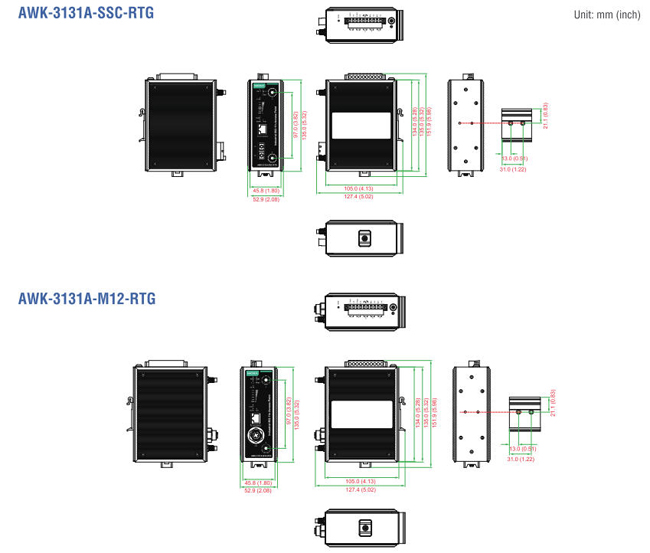
| Dimensions | 52.9 x 151.9 x 127.4 mm (2.08 x 5.98 x 5.02 in) | ||||||||||||||
| Weight | 850 g (1.87 lb) | ||||||||||||||
| Installation | DIN-rail mounting, Wall mounting (with optional kit) | ||||||||||||||
| Power Parameters | |||||||||||||||
| Input Current | AWK-3131A-M12-RTG models: 0.85 A @ 12 VDC, 0.22 A @ 48 VDC AWK-3131A-SSC-RTG models: 1.0 A @ 12 VDC, 0.27 A @ 48 VDC | ||||||||||||||
| Input Voltage | 12 to 48 VDC, Redundant dual inputs, 48 VDC Power over Ethernet | ||||||||||||||
| Power Connector | 1 removable 10-contact terminal block(s) | ||||||||||||||
| Power Consumption | AWK-3131A-M12-RTG models: 10.5 W (max.) AWK-3131A-SSC-RTG models: 13 W (max.) | ||||||||||||||
| Reverse Polarity Protection | Supported | ||||||||||||||
| Environmental Limits | |||||||||||||||
| Operating Temperature | -40 to 75°C (-40 to 167°F) | ||||||||||||||
| Storage Temperature (package included) | -40 to 85°C (-40 to 185°F) | ||||||||||||||
| Ambient Relative Humidity | 5 to 95% (non-condensing) | ||||||||||||||
| Standards and Certifications | |||||||||||||||
| EMC | EN 61000-6-2/-6-4 | ||||||||||||||
| EMI | CISPR 32, FCC Part 15B Class B | ||||||||||||||
| EMS | IEC 61000-4-2 ESD: Contact: 8 kV; Air: 15 kV, IEC 61000-4-3 RS: 80 MHz to 1 GHz: 20 V/ m, IEC 61000-4-4 EFT: Power: 2 kV; Signal: 2 kV, IEC 61000-4-5 Surge: Power: 2 kV; Signal: 2 kV, IEC 61000-4-6 CS: 10 V, IEC 61000-4-8 | ||||||||||||||
| Cybersecurity | EN 18031-1 | ||||||||||||||
| Railway | EN 50155, EN 50121-4 | ||||||||||||||
| Railway Fire Protection | EN 45545-2 | ||||||||||||||
| Radio | EN 301 489-1/17, EN 300 328, EN 301 893, MIC, FCC ID SLE-WAPN008, SRRC, NCC, IDA | ||||||||||||||
| Safety | UL 60950-1, IEC 60950-1, EN 60950-1 (LVD) | ||||||||||||||
| MTBF | |||||||||||||||
| Time | AWK-3131A-M12-RTG models: 552,454 hrs AWK-3131A-SSC-RTG models: 528,478 hrs | ||||||||||||||
| Standards | Telcordia Standard SR-332 | ||||||||||||||
| Warranty | |||||||||||||||
| Warranty Period | 5 years | ||||||||||||||
| Details | See www.moxa.com/warranty | ||||||||||||||
| Package Contents | |||||||||||||||
| Device | 1 x AWK-3131A-RTG wireless AP/client | ||||||||||||||
| Installation Kit | 1 x DIN-rail kit, 2 x cap, plastic, for RJ45 port, 1 plastic protective cap for fiber port (AWK-3131A-SSC-RTG only), 1 x cable holder with screw | ||||||||||||||
| Documentation | 1 x quick installation guide, 1 x warranty card | ||||||||||||||
1. DFS (Dynamic Frequency Selection) channel support: In AP mode, when a radar signal is detected, the device will automatically switch to another channel. However, according to regulations, after switching channels, a 60-second availability check period is required before starting the service.
2. DFS (Dynamic Frequency Selection) channel support: In AP mode, when a radar signal is detected, the device will automatically switch to another channel. However according to regulations, after switching channels, a 60-second availability check period is required before starting the service.
Ordering Information
| Model Name | Band | Connector | Conformal Coating |
|---|---|---|---|
| AWK-3131A-M12-RTG-EU-T | EU | M12 | - |
| AWK-3131A-M12-RTG-US-T | US | M12 | - |
| AWK-3131A-M12-RTG-JP-T | JP | M12 | - |
| AWK-3131A-M12-RTG-EU-CT-T | EU | M12 | ✔ |
| AWK-3131A-M12-RTG-US-CT-T | US | M12 | ✔ |
| AWK-3131A-M12-RTG-JP-CT-T | JP | M12 | ✔ |
| AWK-3131A-SSC-RTG-EU-T | EU | Single-mode | - |
| AWK-3131A-SSC-RTG-US-T | US | Single-mode | - |
| AWK-3131A-SSC-RTG-JP-T | JP | Single-mode | - |
| AWK-3131A-SSC-RTG-EU-CT-T | EU | Single-mode | ✔ |
| AWK-3131A-SSC-RTG-US-CT-T | US | Single-mode | ✔ |
| AWK-3131A-SSC-RTG-JP-CT-T | JP | Single-mode | ✔ |
 I clienti che hanno visto questo prodotto hanno anche consultato